

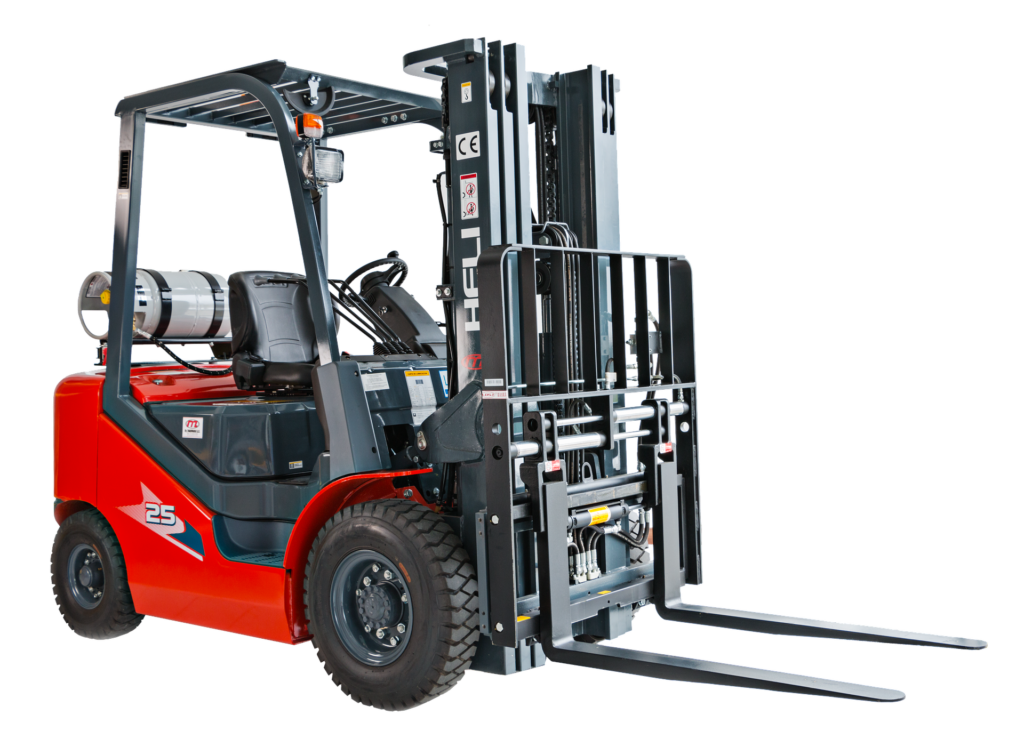
It is crucial that we spread this knowledge throughout the lift industry and that it’s communicated to freight lift users as well. If your potential supplier hasn’t been informed of your intention to load your freight lift using a forklift, it will not be compliant, and there is a serious risk of horrific injury, not to mention constant lift technician call outs, and significant damage or the complete destruction of your lift.
“Surely you are exaggerating?” you might ask.
Well, if you can guarantee, with complete certainty, that the forklift front wheels will never touch the lift under any circumstances, then yes. However, if the forklift front wheels might touch the car sill, then you have a major issue.
“So if I have a freight lift with a 2500kg capacity, and a forklift rated for the same load, how bad is it if only the front wheels enter the lift?”
Unfortunately, the front wheels of the forklift carry most of the load. For example, a Doosan B25X-7 forklift carrying a 2500kg payload applies a front axle load of 6275kg, or two and a half times your rated load. This is, of course, a major problem. For interest’s sake, the back wheels in this situation would apply just 848kg when the forklift is fully loaded.
“Will the lift’s ropes snap then?”
Fortunately not, provided that your ropes are in good condition. The ropes have a conservative minimum safety factor, 8 in the case of goods only hoists, and at least 12 if the lift will carry people as well. The repeated overloading of the diverter pulley shafts is more likely to be an issue, along with the thimble springs which were certainly not designed for the load they are experiencing during loading/unloading. Damage to either of these components will cause major issues.
“So if I just get stronger diverter pulley shafts and thimble springs, then my lift will be fine?”
Your lift will still be illegal and extremely dangerous. You still have to consider the car frame, car base, guide rails, guide shoes, and the lifting machine itself. If you have a traction setup, which most freight lifts use, you will not have enough friction in the grooves to hold the lift during loading/unloading either. Additionally, if the worst were to happen and the lift actually fell, the safety gear would need to stop a load that exceeds its rated load. This is, of course, all unacceptable.
“Why would the guide rails be a problem?”
The design of lift systems is far more complex than many people realize. It is not realistic to expect everyone in the industry to fully understand the physics involved. However, the consequence of the knowledge gap in this area is that horizontal loads are often overlooked or not communicated, which is a particularly concerning thought for structural engineers who are responsible for the lift shafts. For simplicity, imagine that the lift’s suspension position lines up with the guide rail position on a particular lift. Then picture a forklift’s front wheels that are positioned exactly on an imaginary line drawn between the guide rails on either side of the car, with the rear wheels of the forklift still supported by the building. In this case, the forklift will only cause horizontal loads during its braking/acceleration movements due to friction between the tyres and the car floor. However, if those front wheels are positioned somewhere near the car door, that will create a moment on the lift car which needs to be counteracted by a horizontal load at the guide shoe/guide rail interface. In most cases, this load will result in non-compliant guide rail setups based on the limits for guide rail deflection and stress. The car frame must also be able to handle these loads, and since it was designed for a load that is just 40% of what is being applied, and based on a load distribution that was far less concentrated, most car frames will fail completely.
“Okay that’s enough, I get it. So what can I do if I can’t run my facility without using forklifts to load my freight lifts?”
If pallet jack loading truly isn’t viable, and your car dimensions are such that you can’t prevent the forklift front wheels from entering the car, the problem can only be partially resolved at best. Assuming that you can’t stop your facility again to completely strip out the under spec’d unit and replace it with a product that is compliant, safe, and fit for purpose, then you could try reducing the capacity of your unit and the forklift that is loading it, and then upgrade the unit to suit the new requirement. The extent of the upgrade will depend on the unique situation and won’t necessarily be viable, but the option is worth investigating in some cases.
This upgrade would be extensive, so the natural approach would be to request quotes from multiple companies, which in itself is not an issue at all. However, the concern comes in when lift companies truly believe they can offer an appropriate solution, but they don’t have access to the engineers they need to confirm that their proposal is actually acceptable. Alternatively, perhaps they have enlisted assistance from external engineers who don’t operate in the lift industry and consequently do not know the relevant lift regulations, operations, functions, or assemblies well enough to produce a solution that is safe and legally compliant. It will also be tempting to award the contract to the cheapest supplier since the project is running over budget. The risk, however, is that even after all of this hassle, you may well end up in the same position as before, where your unit is still a hazard, and still not compliant.
To avoid this risk, it is highly recommended that you involve a reputable lift consulting company to assist, since they will know which lift companies in your area employ suitably qualified engineers and which companies are not ideally equipped to run with a project with this kind of complexity. Ideally, the lift consultant running with your project would also be an engineer who can validate the required engineering calculations and the proposed solutions.
Lastly, it is crucial that the painful lessons learned through this experience are communicated throughout your own company and to other companies that will undoubtedly end up in similar situations on their own properties. This situation has come up many times already and will continue to happen in future if we aren’t able to share the knowledge as deeply as we need to.