

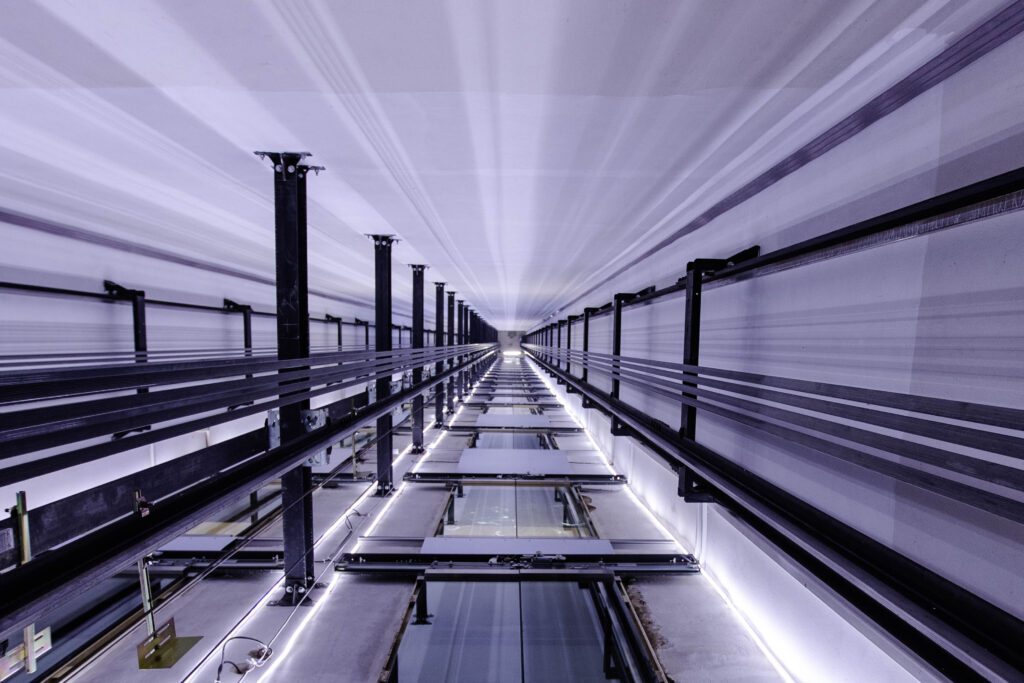
Guide rails play a crucial role in a lift’s
safety system. If the guide rail setup falls short of the requirements, the last
line of defence in an emergency will not be fully functional. In the best case,
the installation may be illegal, with neither the user or the lift supplier or
the lift inspector ever realising. In the worst case, free fall to the bottom
of the shaft if the guides rip out of the wall or if the safety gear can’t
maintain contact with severely deformed guide rails. That’s a terrifying
thought…
So how do you
know if your guide rails are suitable for the loads they will experience during
safety activation? Unfortunately, in most situations, you don’t. Will the lift
inspector check for you? In general, they won’t be able to verify it for you
either, but they should notice if something is highly suspicious based on what
they have seen previously and then query it before signing off on the lift
installation. Ultimately though, you have to either trust your chosen supplier,
or specifically request external verification from a company like ours if you
are suspicious of a potential issue but it’s already too late to change
suppliers. If you have selected a reputable lift company, you should be all
clear, but if there is an awkward meeting where your chosen lift supplier is
unable to convincingly provide static and dynamic force details, particularly
on cantilevered or high capacity lifts, that’s a serious concern.
A natural thought in response
to the guide rail strength concern is that the load test during commissioning
will surely reveal if there is an issue. This is partially true, but only if
the guide rails are severely underspecified. Load tests are not aimed at
testing guide rails because a genuine guide rail strength test is not feasible
as a practical test on a real life installation. The loads experienced during
normal use usually don’t determine the spec of your guide rail. For heavy-duty
units, especially those loaded by a forklift, the forces experienced during
loading/unloading are sometimes the worst that will be experienced, which would
make it feasible to test to some extent. However, in general, guide rails are
specified based on the dynamic loads experienced during emergency safety gear
activation with an offset load in the lift, and this is more problematic to
test sufficiently.
There are many factors to consider in a guide
rail strength check. The impact factor (determined based on the safety gear),
certain car dimensions, the vertical distance between car guide shoes, the
vertical distance between guide brackets, the capacity, car mass, the position
of the car’s centre of mass vs the guide rails vs the suspension points, along
with a couple additional values all have to be factored into the calculations.
Fortunately, the required formulae for most cases are conveniently detailed for
us in SANS 50081-50:2017, allowing us to fairly easily determine the maximum
guide rail stresses and deflections and specify the guide rails and guide
bracket layouts appropriately.
Many people, even in the lift industry, are
surprised to learn that there are significant horizontal loads that are applied
on a lift’s guide rails, which are then transferred to the building walls. We
have seen many drawings that either don’t detail the horizontal loads at all,
or that detail them only in part, or just incorrectly. This is especially
concerning on large units. Unfortunately, most structural engineers see the
vertical loads, the ones they naturally expect, and then understandably proceed
based on the belief that the loads have been fully and correctly detailed for
them. The horizontal loads, and crucially, the distance from the side walls to
the guide rails, must be communicated to the structural engineer who is taking
responsibility for or designing the lift shaft.
The distance from the guide
rails to the side walls might seem irrelevant at first glance, but this
position has a significant impact on the “pull out” forces at the fixing points
between the guide brackets and the shaft walls. Where there is a desire to use
a brick shaft rather than concrete, this detail becomes even more critical
considering the difficulties in appropriately anchoring guide brackets into
brickwork. The distance between the guide rails and the supporting shaft walls
has a significant impact on guide bracket design and the forces imposed on the
building. Shaft changes and surprises, especially those that occur late in a
project timeline, must be extremely carefully managed.
Another common thought is that if the existing
building was suitable for the old lift, it will surely be fine for the new one.
This thought process is reasonable, but only if the fully detailed loads are
compared to ensure that they are very similar, and provided that the original
structure was approved by a suitably qualified structural engineer who
understood the load situation. For goods hoists in particular, adding safeties to
installations that had no safeties before (there are still many goods hoists
like this in South Africa, but this is slowly improving) will radically change
the loads experienced by the building. If the documentation isn’t available for
the original unit but it did have safeties, and there were no issues over the
years, there may be a temptation to assume that a structural engineer is not
required. However, a full load safety gear activation with an offset load
position in the car at just the wrong spot in the lift shaft might not have occurred
yet, which can very easily create a false sense of security. Our
recommendation, considering how dangerous lifts can be, is to always check the
lift and building for genuine compliance and suitability.
The considerations discussed
above are not exhaustive, but they are sufficient to highlight the importance
of a proper analysis of a lift’s guide rail setup and the resulting effects on
a building. In most cases, it is reasonable to expect that a reputable lift
supplier will ensure that the loads are accurately and appropriately detailed.
However, for unique shafts, high capacity lifts, or late changes to either the
lift or the shaft, the impact on the forces and moments involved really mustn’t
be overlooked. If you would like advice in this regard, please free to get in
touch with our team who will gladly assist.